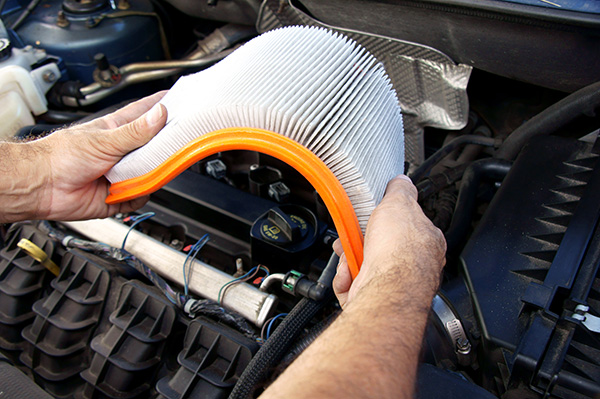
Your engine pulls in a large volume of outside air every time you drive. Before that air reaches the intake, it passes through the engine air filter, which traps dust, sand, leaves, and other debris that should never enter the cylinders.
As the filter fills with dirt, airflow through it becomes harder. A slightly dirty filter is normal and does not mean the engine is being starved for air. The question is whether the filter has become restricted enough to affect engine performance or whether it simply looks dirty from doing its job.
A Dirty-Looking Filter Is Not Always Restricted
Engine air filters rarely stay bright and clean for long. Dust collects between the pleats, and the material can darken after thousands of miles. Appearance gives us useful information, but color alone does not tell the whole story.
When we check a filter, we look between the pleats for heavy buildup, leaves, insects, oil contamination, moisture, and sections where the filter material has started collapsing. A filter packed deeply with debris is different from one with a light coating of dust across the surface.
What You Might Notice While Driving
A severely restricted filter can reduce the amount of air available when the engine is under heavier load. The difference is more likely to show up when you ask for power than while the engine is simply idling in the driveway.
Possible clues include:
- Slower response during hard acceleration
- The engine feels weaker while climbing a hill
- Power drops off more noticeably at higher rpm
- Fuel economy changes without another clear reason
- The filter is heavily packed with dirt or debris
- The engine struggles more when you press the accelerator deeply
Those symptoms do not prove the filter is responsible. Fuel delivery, ignition, exhaust restriction, sensors, and other engine problems can create similar complaints.
Modern Engines Can Compensate for Some Restriction
Modern fuel-injected engines measure or calculate how much air is entering and adjust fuel delivery accordingly. Because of that, a mildly dirty air filter does not automatically make the engine run excessively rich or cause an immediate drop in fuel economy.
The bigger concern comes when restriction becomes severe enough that the engine cannot pull in the amount of air it needs under load. At our shop, we don't blame the filter for every hesitation just because it has some dirt on it. We compare its condition with the symptoms and check for other causes when the engine still performs poorly after airflow is restored.
Driving Conditions Affect How Fast the Filter Gets Dirty
There is no perfect replacement interval for every driver. A car that spends most of its time on clean paved roads may keep its filter usable much longer than a vehicle regularly driven through construction areas, dusty rural roads, or heavy airborne debris.
Where the air intake is positioned also makes a difference. Some vehicles seem to collect leaves and dirt in the air box faster than others. If you drive in dusty conditions, checking the filter more frequently makes more sense than relying only on mileage.
How Often Should an Engine Air Filter Be Replaced?
The owner's manual is the best starting point because manufacturers set different schedules for different vehicles. Many replacement intervals fall somewhere in the range of tens of thousands of miles, but driving conditions can shorten that considerably.
Instead of replacing the filter automatically at every oil change, we prefer to check its actual condition when practical. Regular maintenance gives us repeated chances to see how quickly debris is building up on your particular vehicle. If the filter is still in good condition and airflow is not restricted, replacing it early provides little benefit.
A Damaged Filter Can Be Worse Than a Dirty One
Restriction is not the only reason an air filter needs replacement. Torn filter material, a crushed frame, damaged seals, or an incorrectly installed filter can allow unfiltered air to bypass the element.
During an inspection, we also look at the air box and make sure the filter sits correctly against its sealing surface. Dirt downstream of the filter is a warning sign because it suggests debris has found another path into the intake. That deserves attention even if the filter itself does not look heavily clogged.
Why Replacing the Filter Correctly Is Important
Installing an engine air filter sounds simple, but it needs to fit correctly. A filter that is the wrong size or pinched during installation can leave a gap around the edge. Loose air-box clips or a cover that does not seat completely can create the same problem.
We also check that nothing has fallen into the lower air box while the filter was removed. Leaves and debris left underneath a new filter can quickly block part of its surface. The goal is not simply to install a clean element. It is to make sure all incoming air passes through that element before reaching the engine.
Get Engine Air Filter Service In Fairburn, GA, With Gowen's Automotive Repairs
If your engine feels weaker under load or you are unsure whether the air filter is overdue for replacement, Gowen's Automotive Repairs in Fairburn, GA, can check the filter, air box, and intake system for restriction or damage.
Schedule a visit and have the filter replaced when its actual condition shows that it is no longer doing its job properly.